The rapid spread of Prosopis juliflora has created both ecological strain and social challenges across Marsabit County. Yet for Caritas Marsabit, this crisis has also opened a door. Rather than focusing only on the damage caused by this invasive species, we are finding practical ways to turn it into an asset. By managing and utilising Prosopis responsibly, we’re helping communities strengthen their resilience, create new livelihood opportunities, and advance long-term sustainable development.
Prosopis juliflora (locally known as Mathenge) is an aggressive, non-native tree species that has overtaken large areas of land, especially in vulnerable zones like Bura Northhorr. Its rapid spread replaces native vegetation, strains already limited groundwater, and turns essential grazing areas into unusable thickets posing a direct threat to the pastoral livelihoods that sustain the region.
Yet within this threat lies an unexpected opportunity:
“Although the branches look weak when the tree is young, I’ve come to learn that Prosopis is a hardwood species. With proper spacing and management, it can produce strong timber and durable poles for construction. The challenge, however, is its invasive nature, its seeds germinate faster, making the species incredibly difficult to control.”- Ibrae Wakera – Livelihoods manager, Caritas Marsabit.
Our Three-Pillar Strategy for Sustainable Intervention
At Caritas Marsabit, we are applying an integrated approach that addresses the spread of Prosopis juliflora while strengthening community resilience through food production, income generation, and pastoral support. In simple terms, we turn the problem into the solution.
“The activities in Bura work perfectly together. Mechanized tools will speed up clearing, which will boost briquette production and expand the land available for farming.”
Ibrae Wakera, Livelihoods Manager, Caritas Marsabit
1. Climate-Smart Agriculture: Restoring Land for Food Security
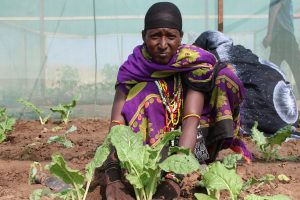
Action: Clearing Prosopis-infested plots and converting them into productive farmland.
Impact: The reclaimed land supports 30 female-headed households with year-round food production, improving nutrition and reducing vulnerability to climate shocks.
2. Circular Economy & Clean Energy: Turning Invasion into Income
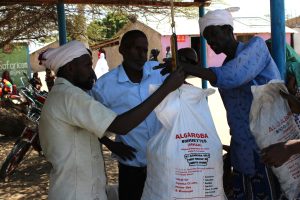
Project participants selling briquettes at a market day in North-horr.
Action: Community groups process Prosopis wood into eco-friendly briquettes.
Impact: This generates a reliable income source, provides a clean energy alternative, and keeps the value of the resource within the community.
3. Smart Fodder Production: Protecting Pastoral Livelihoods
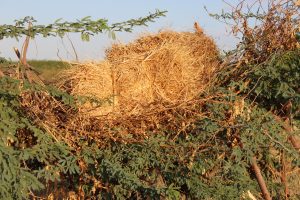
Action: Establishing fodder farms on cleared land near dependable water points.
Impact: Ensures steady access to animal feed, helping pastoral households withstand drought and climate variability.
This integrated model not only contains Prosopis but strengthens food systems, incomes, and the environment. Encouraged by the progress, participants are eager to expand their efforts.
“I am very grateful for the support Caritas has given us through the Bura irrigation project. Clearing this land and starting production has changed our lives. We now hope to scale up the work perhaps with a power saw so we can clear even more land for food and fodder production.”- Talaso Isacko, Project participant
This approach demonstrates how a challenge as disruptive as Prosopis juliflora can be transformed into a genuine driver of resilience and opportunity. By reclaiming land, generating new income sources, and restoring food production, families are beginning to see real, tangible change in their daily lives.
Most importantly, the work reflects a commitment to listening to communities and responding to their needs. Caritas Marsabit remains ready to stand with them supporting practical tools, skills, and opportunities that strengthen their future and ensure that no one is left behind.
Follow our journey, learn more about our work and help us amplify the voices of the communities we serve, follow us on our social media pages: https://www.facebook.com/caritasdom/ https://x.com/caritasmarsabit?t=Q-KBGn668gVpW5H8G6IBlw&s=08